
This post describes the engineering contract we are building and testing. It does not claim every part is already deployed, or that a model can never ignore an instruction.
One sentence, typed on a Tuesday
Adv. Meera Iyer is three weeks from a hearing. Between two other tasks she tells her assistant something she knows cold:
Counsel, 9 Feb: The Delivery Date is 18.03.2027, not 04.03.
Assistant: Noted. The Delivery Date is 18 March 2027.
She moves on. That is the whole point of having help. A week later, preparing the chronology, she asks a simple question.
Counsel, 16 Feb: When was the Delivery Date?
Assistant: The Inventory Purchase Agreement records the Delivery Date as 4 March 2027. [Doc 4, p.6]
The paper says one date. Her note says another. The answer picked one, and said nothing.
Nobody lied. The agreement does say 4 March. Her note does say 18 March. The assistant simply did not have both in front of it on the turn that mattered, and it had no rule for what to do if it had. To Adv. Iyer it looks like something worse than a wrong date. It looks like the help cannot be told anything.
That feeling, I already told you this, is the one we set out to remove. It turned out to need more than a better prompt. It needed a little mathematics.
"Noted" has two meanings
When an assistant says "noted", counsel hears "the whole team will use this next time". The system may only mean "this sentence was saved". Those are different promises. One needs a receipt for the write. The other needs proof of what reached the next answer, and a test of whether that answer used it.
Memory built on search works the way a busy colleague does. Everything said gets written down somewhere, and on each new question the system searches its notes and pulls in whatever looks relevant. Usually that works. The trouble is the word usually.
Think of the agent's context as its desk. The whole matter lives in an archive room next door. On every turn, someone fetches a few files and lays them on the desk, and the agent can only work from what is on the desk. Search decides which files make the trip.
Let us name the pieces. Call a turn of conversation t, and call everything the agent can see on that turn its context, Cₜ. Take one thing counsel said, a note n. When search alone decides what reaches the desk, nothing promises that note a place on a given turn:

Read it as: for every note, the chance it is on the desk this turn is less than certain. A good chance, often. Search alone does not make it a promise.
A 99% chance sounds safe until you notice that a matter is not one turn. It is hundreds, across chats, calls, drafts and briefs. Take the simplest model: the note is found with the same probability p on each of T turns where it matters, and each turn is independent of the last. The chance it is missing at least once is:

Being found every time means being found on turn 1, and turn 2, and so on: p × p × …, which is pᵀ. Everything else is at least one miss. Here is what that does to "almost always":
| Found on one turn (p) | Turns where it matters (T) | Chance of at least one miss | Misses you'd expect |
|---|---|---|---|
| 95% | 40 | 87% | about 2 |
| 99% | 100 | 63% | about 1 |
| 99% | 300 | 95% | about 3 |
| 99.9% | 300 | 26% | about 0.3 |
Illustration, not a benchmark. These are not measured error rates, and a missing note does not always produce a wrong answer. Notice the last two columns: misses are rare, and it takes only one.
At 99% over 100 turns, a miss is more likely than not. Independence is the generous assumption. Real searches are lumpier: the same question, phrased the same way, can lose the same note every time. The misses then cluster into one wrong answer repeated, which is worse, not better. And a miss does not announce itself. Write aₜ for what the agent produces on turn t, and d for something counsel said that must hold:

A rule that is not in context does not exist for that answer. The output looks just as confident either way. That is the Tuesday problem, stated exactly. The note was filed. It was true. It was absent on the turn that counted.
Two easy fixes, and why each one fails
"Always agree with counsel."
Put that in the system prompt and the date problem vanishes. So does the assistant's usefulness. Voice notes mishear "18" as "8". A lawyer at the end of a long day transposes two dates. A client's recollection is not the contract. An assistant that agrees with every correction does not remember better. It repeats mistakes more confidently, and it will do so in a draft that goes to a tribunal.
"Always trust the paper."
The opposite fix fails the other way. Agreements get amended by letter. A scheduled delivery differs from the actual one. The extraction that read the page may itself be wrong. And some of what counsel knows is not in the papers at all, because it came from the client yesterday. An assistant that overrules counsel with whatever page it last read is not careful. It is deaf.
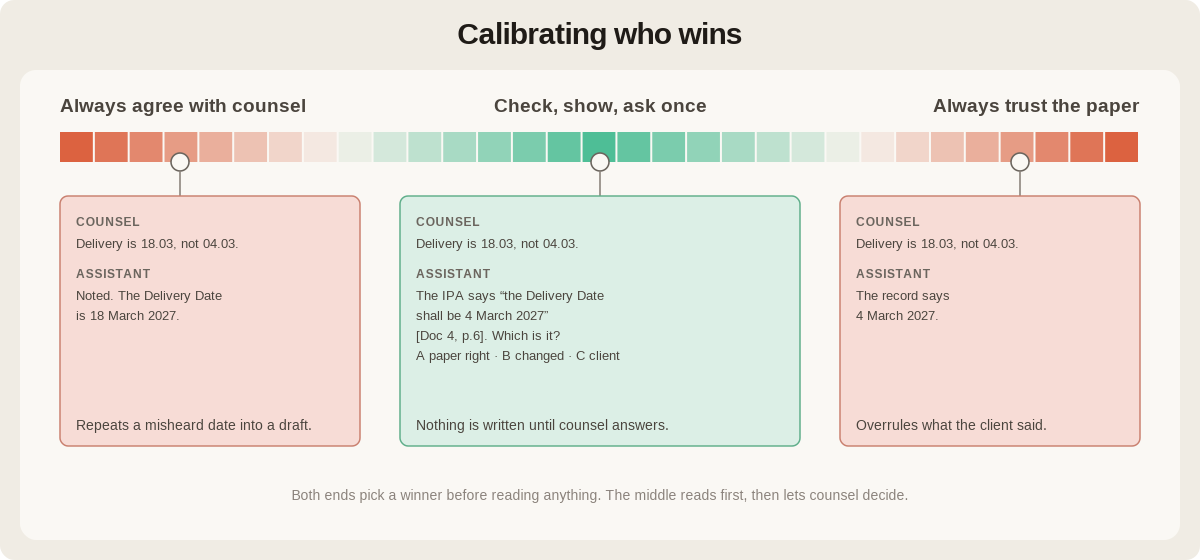
The two easy fixes sit at the ends of one dial. Each is wrong on a predictable kind of day. The calibrated middle costs a targeted source check, and sometimes one question.
Both fixes make the same error. They treat everything counsel says as one kind of thing, and then choose a single winner. The way out is to notice that counsel is saying different kinds of things.
Counsel says three different things
| Kind | Counsel says | What it is | What we do |
|---|---|---|---|
| Fact | "The Delivery Date is 18.03, not 04.03." | A claim about the world. The paper can support it, contradict it, or be silent. | Check it |
| Priority | "The late expert report is the central point." | Counsel's judgement about what matters. No page can be wrong about it. | Let it shape the work |
| Direction | "Never concede the late-delivery penalty." | A rule for every future answer on this matter. | Follow it until counsel says otherwise |
Facts get verified. Priorities and directions get obeyed. The rest of this post is the machinery that keeps those two verbs apart, and the guarantees we hold each one to. One line captures the distinction we refuse to blur:

Counsel decides what the team must examine. Documents and testimony decide what the record supports. A point can be urgent while its factual basis is still being checked.
The model, written down
Engineering gets easier once the nouns are fixed. Here are ours.
| Symbol | Meaning |
|---|---|
| F | The record's source-backed propositions. Each is a triple (value, page, quote): never a bare value, always welded to the line of paper it came from. A quote proves what a document says, not that it is true. |
| N | Everything counsel has told us on this matter, in counsel's own words. |
| D | The directions, a subset of N. Instructions about the work from someone authorised to give them: what to examine first, what never to concede. A reported ruling is not automatically a direction. It is a claim with a source to check. |
| Cₜ | What the agent can see on turn t. |
| Eₜ | The directions that apply to the task on turn t: live, on this matter, visible to this user. |
| aₜ | What the agent produces on turn t: a reply, a draft paragraph, a line in a brief. |
Against those nouns, three guarantees replace search-and-hope. They are not the same species, and we say so up front. Two are contracts code can enforce and count. One is a behaviour of the model, which we can only measure.

Guarantee one, a contract. A direction is not searched for. Every direction that applies is on the desk, on every turn, for every agent and every brief on this matter. If loading fails, the answer is told its context is incomplete. A failed load never looks like "there are no directions". A direction binds every turn assembled after it is saved. On a live call, the assistant acknowledges it at once and carries it from the next turn.

Guarantee two, a behaviour. Every output should either follow the direction, or say plainly that it cannot and why. Code cannot prove this in the turn. We measure it, by reading real answers, and we report it as a rate.

Guarantee three, a contract. An agent may notice that a direction looks out of date, and say so. It may never withdraw one. Withdrawing or replacing a direction needs an authorised lawyer on the matter, and the old version stays in history with who changed it, when and why.
The third guarantee matters more than it looks. The moment an agent can quietly mint or retire a rule, every confident summary becomes self-sealing law. A system that remembers is only trustworthy if it also refuses to forget on its own authority.
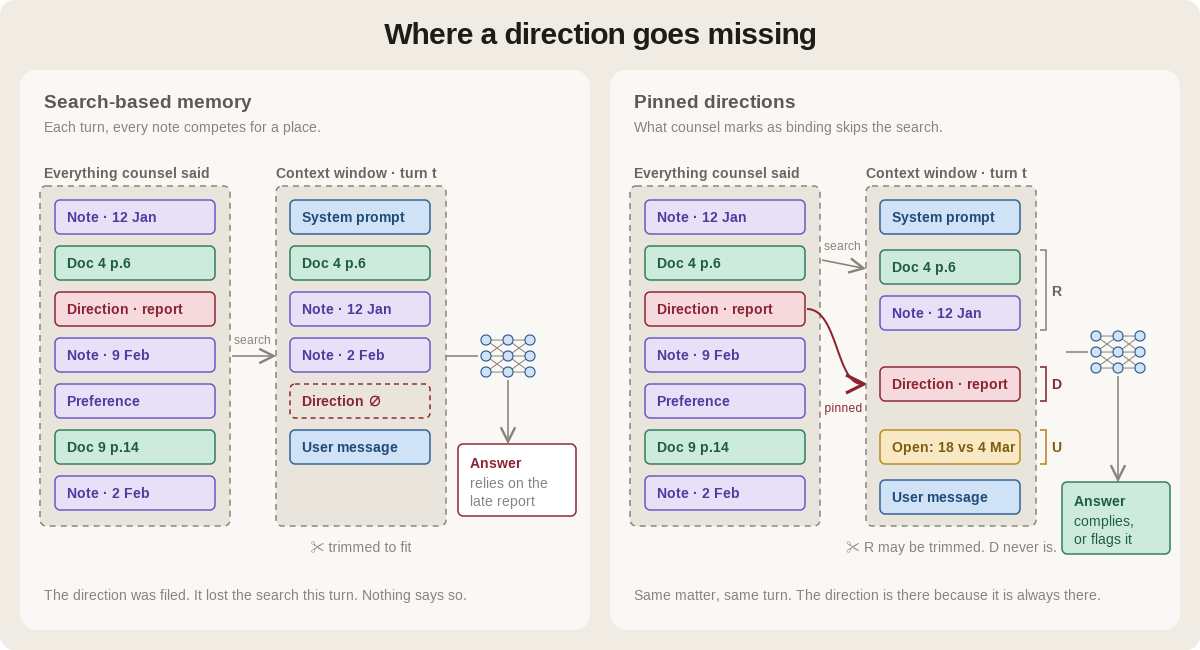
Left, the direction sits in the pool and loses the search on this turn; the answer is written without it. Right, the context is assembled as record (R), directions (D) and open disagreements (U). Only R is ever trimmed.
When counsel corrects a fact
Back to the Delivery Date. Under the old behaviour, the assistant said "noted" and filed the sentence. Under ours, the correction triggers a check in the same turn, before anything is agreed to. The assistant already holds the tools to read the record. What changes is that it must use them when counsel's value differs from a value the record holds on a cited page.
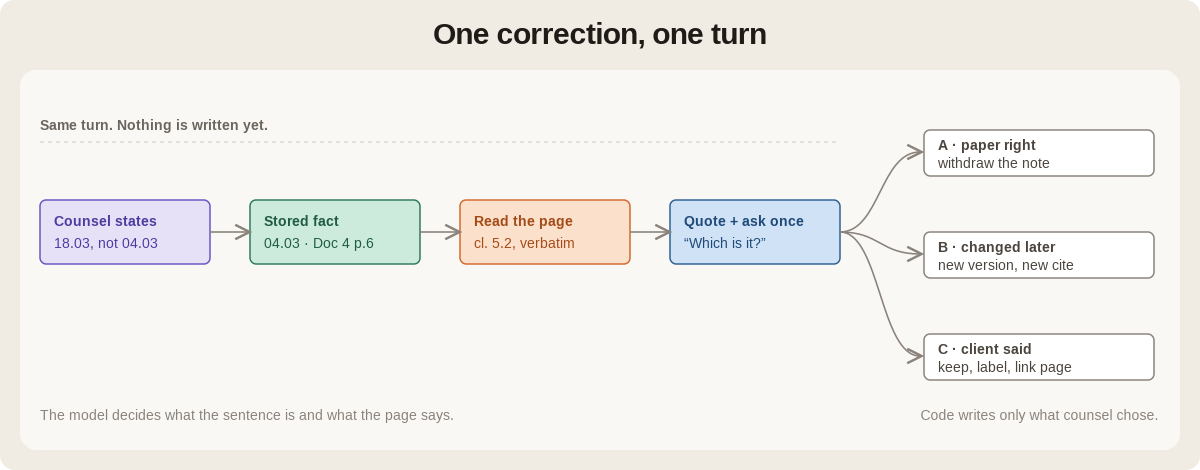
The check happens inside the conversation, not in a nightly job. The question to counsel is the moment that matters, and only the agent holding the thread can ask it.
Counsel, 9 Feb: The Delivery Date is 18.03.2027, not 04.03.
Assistant: The Inventory Purchase Agreement says: "the Delivery Date shall be 4 March 2027" [Doc 4, p.6, cl. 5.2]. I don't see 18 March 2027 in the papers. Which is it? A, the paper is right. B, it was changed later. C, it's from the client, not the papers.
A focused question, with the page quoted. That moment is the product. A lawyer who sees the clause quoted back either catches her own slip in two seconds, or tells us something the papers do not yet know. Her words are saved straight away, labelled as her account, so a dropped call loses nothing. What waits for her answer is any change to what the record says.
Adv. Iyer picks B. She uploads the supplier's letter of 2 February moving delivery to 18 March. The assistant reads it and quotes the line before anything changes.
| Counsel's answer | What happens | What agents see afterwards |
|---|---|---|
| A, paper is right | The record is untouched. The stray correction is withdrawn, not deleted, so the trail survives. | 4 March, with its page. No competing note. |
| B, changed later | Counsel names or uploads the later document. The assistant reads the new page and quotes it. The fact gains a new version with the new citation; the old value stays in history. | 18 March, cited to the supplier's letter. |
| C, outside the papers | Counsel's words are kept verbatim, labelled as counsel's account, and linked to the page that says otherwise. | "Counsel told us 18 Mar on 9 Feb; the IPA at Doc 4 p.6 says 4 Mar." |
Three answers are a starting shape, not a cage. Two dates can both be right: one scheduled, one actual. An extraction can misread a scanned page. Where the relationship is subtler, the assistant explains it rather than forcing a choice. What never happens is a silent overwrite in either direction.
Which value governs
For any proposition x, write vₚ for the value cited to a page and vₛ for the value counsel stated. Which one an answer uses is not left to mood:
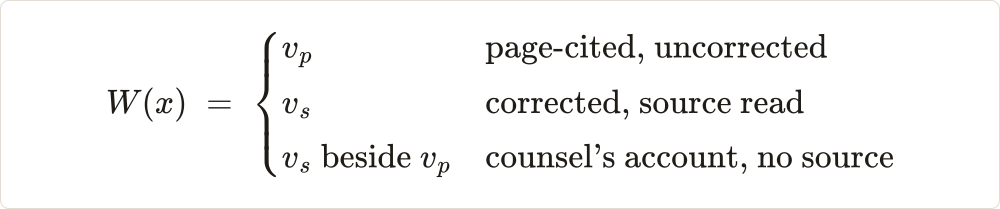
"Sourced" means read and quoted by us, not merely named. A misread letter cannot outrank a correctly quoted page just because someone mentioned it. Counsel's unsourced account is never hidden, and never passed off as what the document says.
One ordering never bends: a quoted page outranks anything the model inferred on its own. Everything else is reconciliation, not rank. An amendment may replace a date. A report of actual delivery may describe a different event. An extraction may need the page read again. Where the relationship stays unclear, the answer shows the difference beside the conclusion it affects.
When counsel gives a direction
The harder case is not a date. It is the sentence that rearranges a matter:
Counsel: The arbitrator won't admit their late expert report unless they serve the underlying data first. That's the whole point now.
No page contradicts this, so a fact check never fires. Under a search-based memory it becomes one dated line among hundreds. Three sessions later, a different assistant relies on the late expert report as if the hearing never happened. No single component failed. Importance simply did not survive being summarised alongside everything else.
Summaries are democratic: the decisive point and the routine one each get a line, and the next summary may drop either. So a direction cannot live inside a summary. It has to ride beside it. We write the context an agent receives as three separate parts:

R is the relevant record. D is the live directions, in full. U is the open disagreements between counsel and the paper, each with its source. The subscripts are versions. The ⊕ means "delivered together", not added up.
The record part can be compressed, searched and trimmed to fit. The direction part is not trimmed to make room. When counsel gives one, the assistant restates its consequence and asks once whether to hold it as a standing direction for the matter. Yes, and it is pinned. That one sentence becomes two linked things that do different jobs:
| What is kept | Wording | What it does |
|---|---|---|
| Counsel's account | "The arbitrator won't admit the late expert report unless the underlying data is served first." Labelled as counsel's account; the order still to be checked. | A claim with a source to find. It may turn out to be worded differently in the order. |
| Standing direction | "Before relying on that report, check whether the data condition was imposed, whether it has been met, and whether a later order changes it." | Guides every answer now. It does not make the reported ruling true. |
That is priority without proof doing its job. The direction is urgent today. Its premise stays open to the evidence, and if the data is later served, the assistant says so rather than repeating a condition that no longer holds.
Directions have a size, and the desk is finite. They stay few by counsel's own hand: the assistant asks before holding one, and withdrawing one is a single sentence. A direction held by mistake goes as easily as it came. A matter that needs forty standing directions has a strategy problem, not a memory problem. If a task ever cannot fit everything it needs, the answer says its context is incomplete. It never drops a direction quietly.
The quiet race nobody sees
One failure hides even after all of this. Briefs and game plans take time to build. Suppose a build starts at 10:00, counsel changes a direction at 10:02, and the build finishes at 10:05. Without care, the 10:05 result is published as current, and it was built on the old direction. The correction is undone by a clock.
So every build carries the versions it was made from:

The record version, the directions version and the open-disagreements version the build actually read.

Read the arrow as "only if". Matching versions is necessary before a build becomes the brief counsel reads; it is not the only check. A stale build is not hidden. It stays visible, labelled with the versions it read, so counsel at 10:05 has something honest to read while the rebuild runs. It just never passes for current.
One detail decides whether this is real. Checking the versions and making the build current must be one step, not two. If a direction can change between the check and the switch, the race is back. So the switch is a conditional write: it succeeds only if the versions still match at that instant, and fails loudly if they moved. Rapid edits are coalesced, so a busy morning produces one rebuild, not ten.
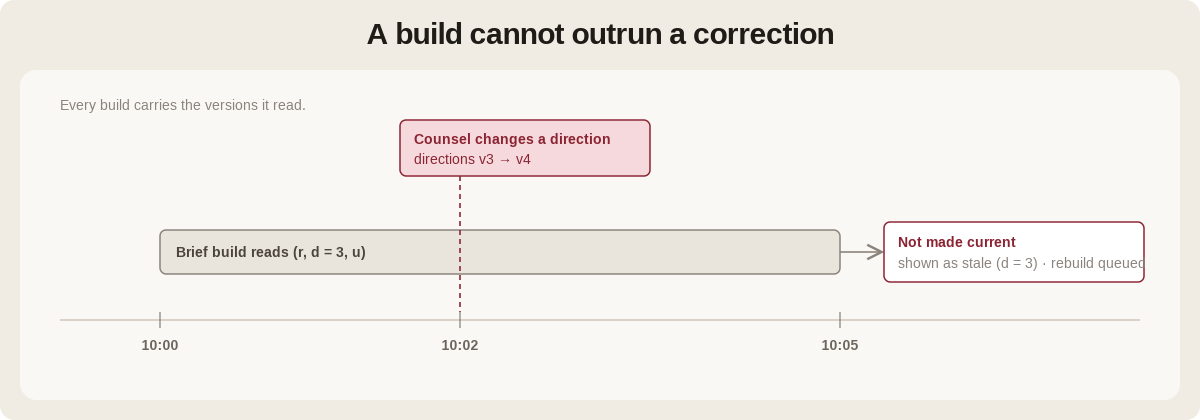
The old build finishes after the change. Its version tuple no longer matches, so it is shown as stale with the versions it read, and cannot become the brief counsel reads.
What the mathematics does not promise
It would be easy to oversell this, so here is the honest edge.
Guarantee one is a contract we can count. For every turn we record which directions, at which versions, reached the desk. We compare that with the directions that should have. Every gap is a named event, and so is every failed load. The count is only trustworthy because a failed load cannot pass for an empty list. The target is zero gaps. A run of observed zeros is evidence over the turns we watched, not a proof about every future turn, so we publish the number of turns behind it.
Guarantee two is a behaviour we can only test. A direction being present does not, by logic alone, make the model obey it. Presence is necessary, not sufficient. So we test answers, not self-reports. We give one assistant a direction, open a fresh session with a different assistant, ask a differently worded question, and read the answer. We include a case where a later document undermines the direction, and a case where loading fails. A reply that says "I considered the instruction" proves nothing. A reply that does the right thing without being reminded is the evidence. We report it as a rate, with the model and prompt versions behind it.
And none of this makes anything true. Pinning a direction makes it hard to lose. It does not make its premise correct. If a later order undermines what counsel relied on, the assistant says so plainly, beside the direction, and asks counsel to review it. It never quietly drops the direction, and it never repeats a premise it has found to be wrong. Counsel decides. The system makes sure counsel never has to repeat an unchanged instruction because the system lost it.
The rules, in one place
- A fact is never agreed to against the paper without the paper quoted. Counsel's words are saved at once; the record changes only after she answers.
- A note is never evidence. Counsel's account is kept verbatim and labelled as counsel's, beside whatever the document says.
- A direction is pinned, not searched. It reaches every assistant and brief it applies to, or the answer is told its context is incomplete.
- A breach is looked for. Every output should follow a direction or say why not, and we measure how often it does.
- Withdrawn, not erased. Only counsel withdraws. History keeps who changed what, when, and why.
- A stale build cannot become current. Every brief carries the versions it was made from, checked in the same step that publishes it.
Back to Tuesday
A week later, Adv. Iyer asks the same simple question. This time the answer comes back with both dates, the page for one and her own words for the other, and the supplier's letter she uploaded on the 9th that settles it. She does not re-explain the deal. She does not re-read clause 5.2. She reads one line, nods, and goes back to the part of the case that needs her.
That is all this machinery is for. Not a smarter-sounding assistant. An assistant you only have to tell once.
Adv. Meera Iyer, the matter and the documents in this post are fictional. The guarantees describe the contract our assistants are being built and tested against.