Two weekends
Picture a construction arbitration, eleven thousand pages of record, hearing in six weeks. The core question: who caused the delay.
The team spends the weekend the way good teams do: researching. Authorities on concurrent delay, on extension-of-time clauses. By Monday there is a strong memo on the law, forty citations deep. That work matters, and it was done well.
What nobody reached was annexure R-47 of the other side's own disclosure: a monthly progress report, page 6,212, where their site engineer recorded that the pour was suspended "pending revised drawings from the employer's consultant." Their document. Their admission. The case, confessed in their own words, three years before anyone thought of arbitration.
Nobody skipped that page out of carelessness. Nobody skipped it at all. It was simply never possible to get there, and it is time the profession said that number out loud.
The arithmetic nobody says aloud
A person reads around 240 words a minute; a page of record carries around 300. Now do what no one does in front of a client:
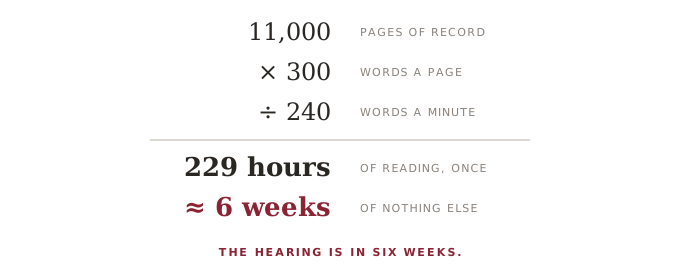
Six weeks of reading and nothing else, to get through the record once, with no notes taken, nothing cross-referenced, nothing remembered a week later. Actual comprehension, the kind that connects page 6,212 to paragraph 40 of their defence, multiplies that several times over. The runway to the hearing is spent before the understanding begins.
So let us say plainly what this means, because it lifts a weight lawyers have been carrying alone: not reading your whole record is not a failure of diligence. It is not humanly possible. No amount of talent, coffee, or weekend heroics changes the arithmetic, and no lawyer should be measured against it.
The flood is not an accident
Here is the part that turns a hard problem into an adversarial one: the other side can count too.
A better-resourced opponent does not need to hide R-47. They only need to disclose it at page 6,212 of eleven thousand, inside a flood they helped create, and let the arithmetic do the rest. Every page you cannot reach is a fact you cannot use, and volume is the cheapest weapon in litigation: it costs them a truck, and it costs you the case. The drowning is not a byproduct of modern disputes. For the side with more paper, it is the strategy.

Against a deliberate flood, working harder is not a defense, because the flood is calibrated to exceed any human effort. What you need is something on your side of the table that reads at machine scale and has exactly one loyalty: your attention. Something whose whole job is to walk the eleven thousand pages and come back saying, these nine places deserve you first.
Why PRAMAAN exists
That is the problem PRAMAAN was built to solve. Not to replace research into the law, which remains essential and well served, but to end the strange asymmetry where the public half of your world gets a century of research tools and the private half, your own record, the only place your winning facts live, gets a weekend skim.
So PRAMAAN reads the record the way no human can, and gives it the structure the law has always had: every assertion welded to the exact page that carries it, every dated event on one walkable chronology, every collision between their story and their own documents surfaced as a finding. Nothing is asserted without its source; every answer opens to the page that proves it. And judgment stays where it belongs: counsel decides what R-47 means. The machine's mission is humbler and, at this volume, more urgent: make sure the page that deserves your attention actually receives it, while there is still time to act.
The weekend, returned
Go back to that team, six weeks out. The record went in on day one. By the first afternoon they are not staring at eleven thousand pages; they are reading nine flagged contradictions between the pleaded delay story and the other side's own contemporaneous documents, R-47 at the top, each one open to its page.
The memo on the law still gets written. The weekend still happens. It is just spent the way it always should have been: not searching for the fact, but deciding what to do with it.